New algorithm crafted from old maths
An international team including CQT researchers report an improved algorithm for finding quantum ground states
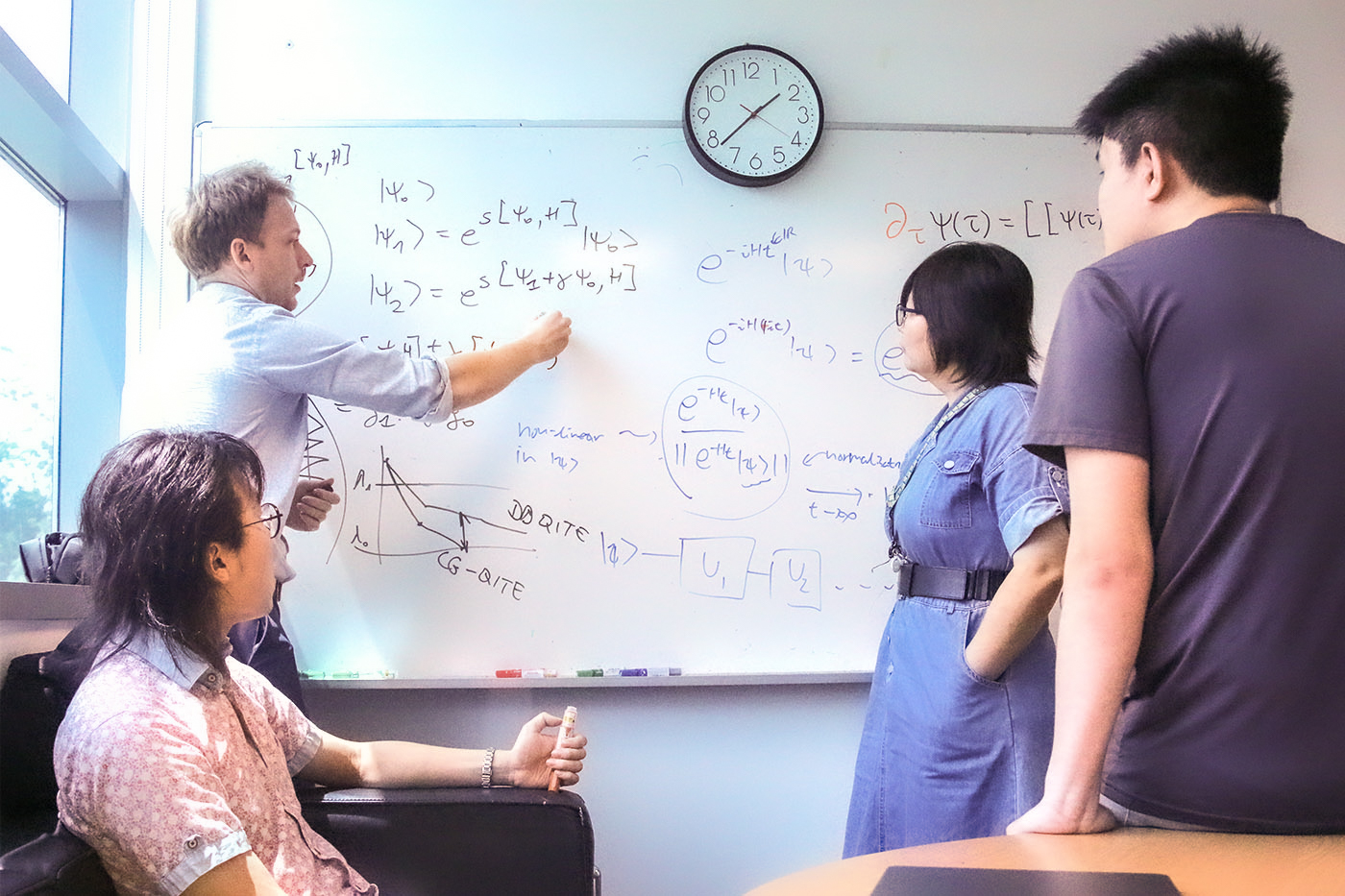
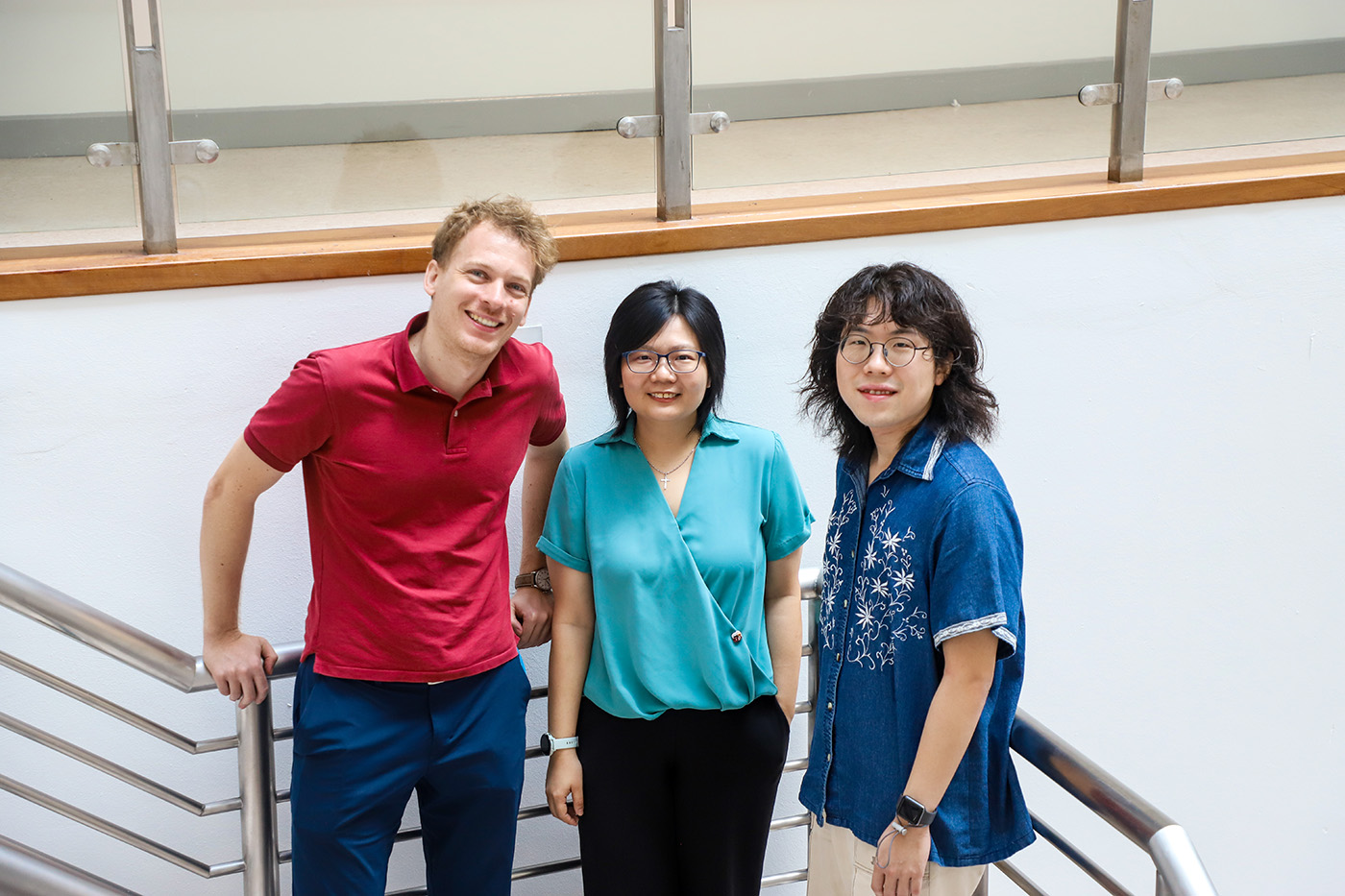
(From left) Group members Jeongrak Son, Marek Gluza, Nelly Ng and Tiang Bi Hong explore how double-bracket flows, first proposed in 1991, can be used for quantum computation.
A new quantum algorithm has been crafted by the group of CQT Fellow Nelly Ng and collaborators.
In a paper published in Physical Review Letters on 12 January 2026, the researchers describe how a mathematical technique first introduced 35 years ago can be repurposed to help quantum computers find many-body ground states.
Finding ground states is helpful in solving optimisation problems, studying the properties of materials and understanding chemical reactions – but it’s challenging for both classical and quantum computers.
The team’s new algorithm uses equations known as ‘double-bracket flows’. First proposed by mathematical engineer Roger Brockett in 1991, the equations were intended for applications such as sorting algorithms and analysing the gradient behaviour of functions.
Nelly and her team members Marek Gluza, Jeongrak Son and Tiang Bi Hong at Nanyang Technological University, Singapore, realised that the same equations could help calculate quantum ground states, by making a known approach that relies on ‘imaginary-time evolution’ more efficient. They worked together with collaborators in Switzerland and Germany to show the efficacy of this approach, which they name ‘double-bracket quantum imaginary-time evolution’ (DB-QITE).
The team found the method guarantees a solution, which is not always the case. “We prove mathematically that it will converge to the ground state,” says Bi Hong. He started the work as a Project Officer and has since become a CQT PhD student.
Going to ground
Algorithms that find quantum ground states typically calculate how a system in some initial state might evolve into the state of the lowest possible energy, which is called the ground state. ‘Imaginary-time evolution’ is a promising framework that describes this process by an unusual form of time evolution – where the evolution time is multiplied by the imaginary number i.
However, good strategies to implement imaginary-time evolution were lacking. Methods proposed so far used block encodings that are beyond the capabilities of today’s quantum computers.
This is where double-bracket flows come in. They can implement imaginary-time evolution in a different way.
Reaching the ground state uses the equations’ gradient-finding properties. “Think of it as trying to go to New York from Singapore. It would be fastest to drill through the earth, going straight through the globe, but we do not have the technology to do that,” says NTU Research Fellow Marek who is the first author of the paper. “Instead, we go on the surface tangentially and those tangential directions are given by double-bracket flows.”
A new tool
The researchers ran numerical simulations of their DB-QITE algorithm. For a system of 12 qubits, they could achieve about 98% fidelity with gate counts in reach of existing quantum hardware. The fidelity measures how close the method gets to the ground state.
They also ran simulations for larger system sizes which are difficult for classical computers to simulate. They found good performance – for example, they achieved about 92% fidelity for a 20-qubit system – with gate counts feasible for near-term quantum hardware using error mitigation techniques.
The team also compared the performance of DB-QITE to the quantum phase estimation (QPE) algorithm, a standard algorithm for finding ground states that is designed for fault tolerant quantum computers. They found DB-QITE outperformed QPE in numerical simulations, achieving high fidelity with fewer gates.
The researchers expect that their algorithm can be used alone or combined with other approaches for ground-state preparation. They invite other researchers to test their algorithm and give feedback.
Their publication is the latest in a series of papers exploring double-bracket flows in quantum computation. They have also published double-bracket algorithms for diagonalisation and quantum signal processing.
“This series of papers is a call to revisit the analytical work that was done by mathematicians early on and see how they make fresh meaning in the context of quantum computers,” says Nelly. “We are trying to systematically add to the toolbox of quantum algorithms.”