Singapore scientists build world’s most accurate atomic clock
Results from the lutetium clock at the Centre for Quantum Technologies and National University of Singapore are presented in Nature
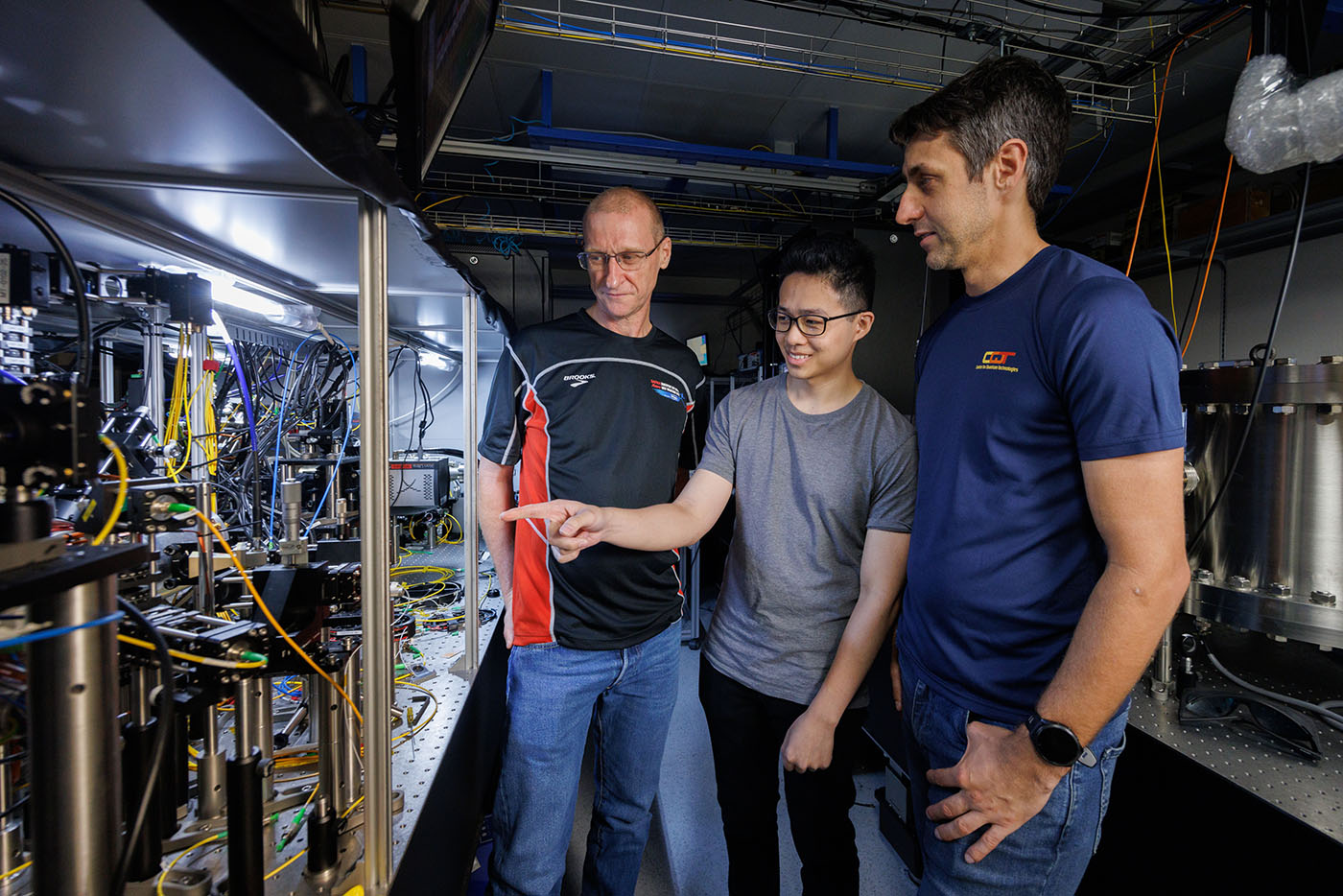
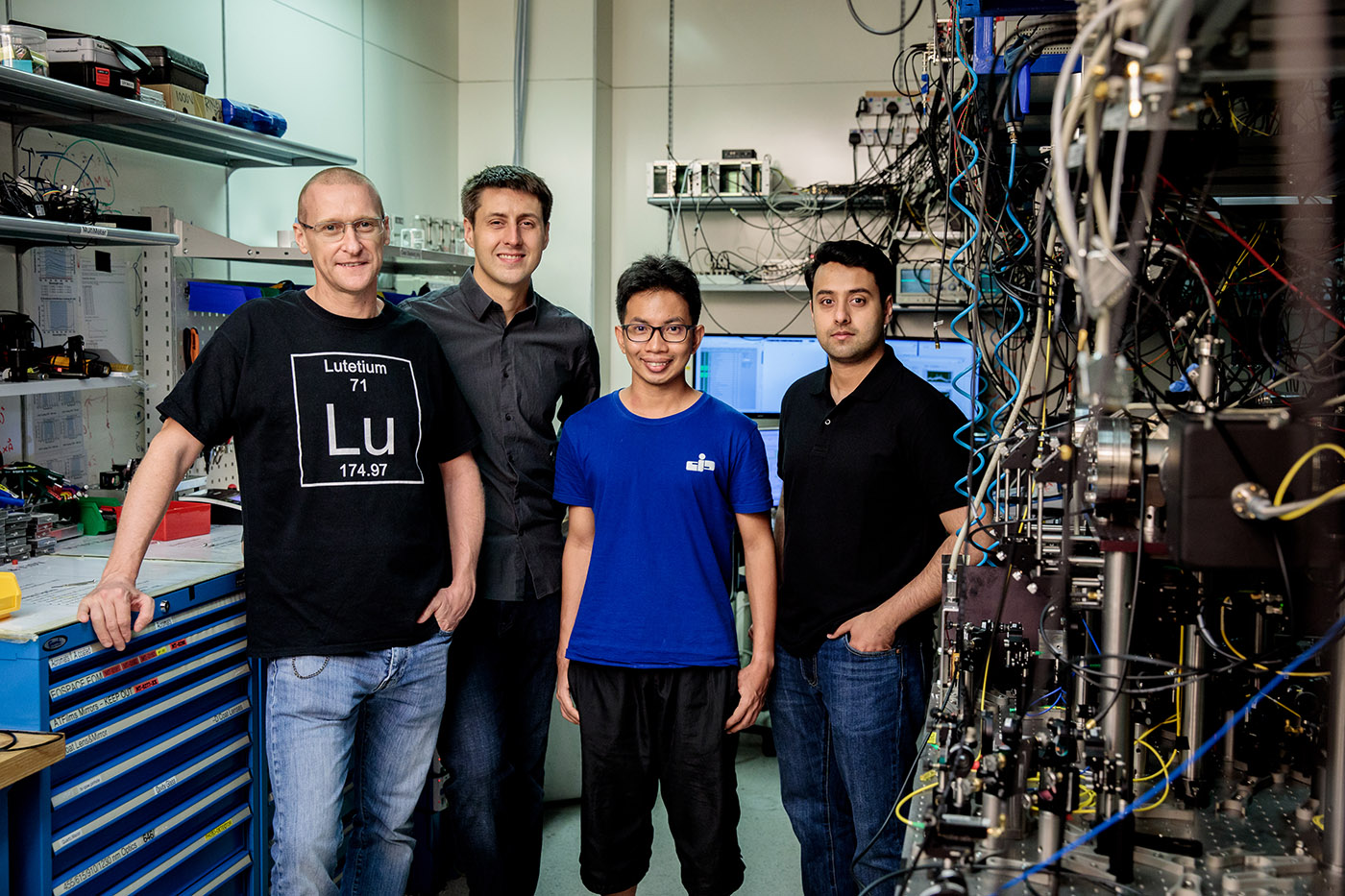
Pictured in the Centre for Quantum Technologies’ lutetium atomic clock lab are (from left) Associate Professor Murray Barrett, PhD student Michael Lee and Senior Research Scientist Kyle Arnold.
Take a second and turn it into trillions of moments. Measure each one. That’s how precisely an atomic clock at Singapore’s Centre for Quantum Technologies (CQT) keeps time – and with record-making accuracy, according to results published in Nature on 23 September.
“I am confident that what we have now is the most accurate clock in the world,” says team leader Murray Barrett, a CQT Principal Investigator and Associate Professor in the Department of Physics at the National University of Singapore.
Murray’s co-authors are group members Senior Research Scientist Kyle Arnold, PhD students Michael Lee and Nakarin Jayjong, and CQT graduates Zhao Qi, Qin Qichen and Zhang Zhao.
The researchers base their claim on measurements showing that their atomic clock, built from the element lutetium, outperforms previous record holders built from different elements.
More accurate clocks hold promise to probe unknowns in fundamental physics and monitor gravitational changes across the Earth – and they are vying to redefine the second.
Pushing the limits of timekeeping
Atomic clocks keep time with reference to an atomic transition, when one of the atom’s electrons swaps energy levels. The frequency of this transition is a fixed property of the atom. A laser is matched to this ‘clock transition’, and the light oscillations act like a pendulum to count time.
The basic method has been in place for decades. Caesium atoms have set the global standard for time since the 1960, and caesium atomic clocks already support the Global Positioning System (GPS) and synchronise communication and transport networks.
But scientists have been pushing the limits of timekeeping with other elements.
Elements such as recent record-holders ytterbium, strontium and aluminium oscillate much faster than caesium, helping them to keep time more accurately. The international body responsible for time standards is considering data from such new optical atomic clocks towards a redefinition of the second expected in or after 2030.
The CQT team started working with lutetium over a decade ago on the hunch that it had the right properties to join the set of top-performing clocks. The team, to its knowledge, is the only group working with this element for timekeeping so far.
Now, the team has measured the frequency of their lutetium clock to 19 decimal places, reporting an uncertainty of 1 x 10-19 which is the lowest reported for any optical atomic clock to date. They also built two clocks and compared their ticking to each other. The clocks agreed to an uncertainty of 5.7 x 10⁻¹⁹, which is the most precise clock comparison ever made. More measurements could reduce that uncertainty further.
Lutetium’s advantage
Lutetium’s strong performance comes from properties of the atom: its clock transition hardly feels changes in temperature or magnetic field. In other elements, these environmental factors can gently vary the frequency of the clock transition.

“In the future, I just don’t see how this clock can be beat,” says Murray. His team has done over a decade of precision engineering on their atomic clock setup, testing different properties of the atom. That work included inventing a scheme called ‘hyperfine averaging’ to define the clock transition.
“The good properties mean that high accuracy can be achieved even in a wide range of environments,” says Murray. “The lutetium clock would be accurate even if you went from the hottest place recorded on Earth in Death Valley to the coldest place in the Antarctic plateau.”
Two is better than one
The team’s confidence is bolstered by their clock comparison, carried out using a technique known as correlation spectroscopy over 200 hours of measurement.
Each lutetium clock consists of a single charged 176Lu+ ion having a clock transition matched to a laser with wavelength of 848 nanometers. Each ion is put into a superposition and left to evolve freely. Even though the laser dephases completely, the ions’ oscillations are still correlated, and measurements reveal the phase difference accumulated during the evolution time.
This allows the researchers to precisely compare the frequencies of the same clock transition, which is one way to validate clock accuracy encouraged by the international roadmap towards the redefinition of the second.
In the scientific literature, the team could find only 12 reports from the last nine years that evaluated the accuracy of optical atomic clocks. Only five of those twelve have been backed up by high-accuracy same-species comparisons, two of which are by the CQT team including their latest work. Although they acknowledge that according to the international roadmap, comparisons are supposed to be between different institutes.
“There is a humorous saying that ‘A man with a watch knows what time it is. A man with two watches is never sure,’” says Kyle, who is joint first author on the paper. “It basically tells you that the only way to test the accuracy of a standard is to compare clocks and demonstrate reproducibility.”
Ideally, the team would also compare their lutetium clock to the world’s other best atomic clocks, but there’s a challenge. Optical atomic clocks at the 10-19 level are so precise they can feel the slowing down of time by gravity over height differences of millimetres. The CQT team’s comparison measurement could resolve a 5mm height difference between their clocks on the same table. To ensure that this did not limit their measurement, they independently measured the height difference of the Lu+ ions below the millimetre level. Differences in gravity between different places on Earth are not yet known well enough to compare clocks at this level.
To enable new comparisons and explore future applications, the clock should come out of the lab. “The next step is to take the lab-scale clock and miniaturise it into a transportable system,” says Michael, joint first author on the paper. The researchers expect they can make their clock smaller without compromising the accuracy.