CQT hosts inaugural Asian Conference on Trapped Ions
The event in Singapore from 20 to 22 April drew 110 participants
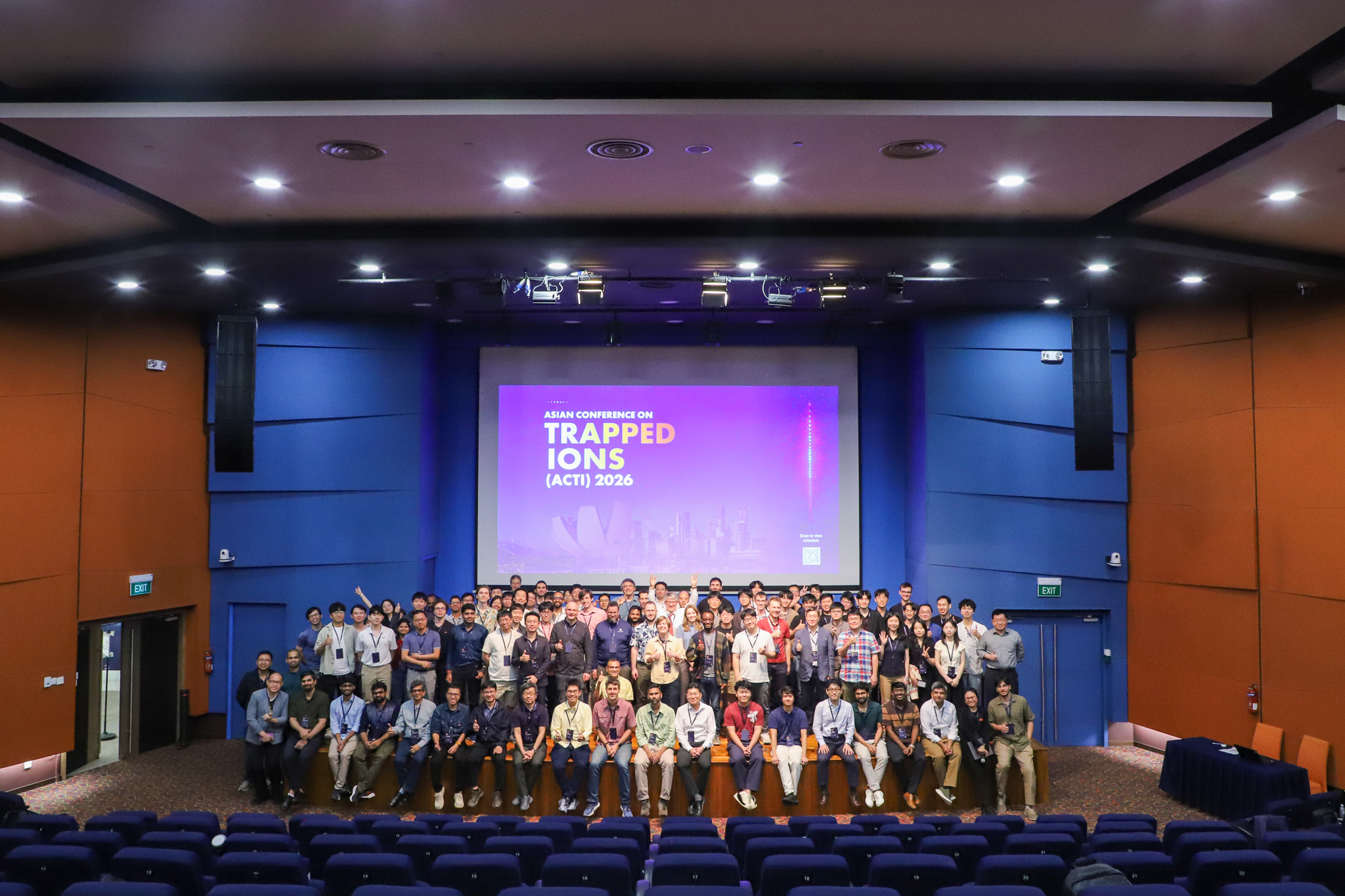
There is a growing community of ion trappers in Asia. They gathered in Singapore for the first Asian Conference on Trapped Ions (ACTI) 2026.
Cool and trap some ions – charged atoms – and you can build quantum computers, atomic clocks, quantum sensors and even test the limits of known physics. Researchers across Asia working on projects of all these sorts gathered in Singapore this April 2026 for the inaugural Asian Conference on Trapped Ions (ACTI).
Some 110 participants attended ACTI 2026, a conference hosted by the Centre for Quantum Technologies on the National University of Singapore campus from 20 to 22 April.
ACTI aims to foster collaboration and exchange between ion trapping groups in Asia, and with international groups in the field. The Asian edition of the conference is modelled after its international counterparts. The North American Conference on Trapped Ions (NACTI) has run since 2017 and the European Conference on Trapped Ions (ECTI) since 2010.
“A few of us meet occasionally at conferences and realised that the number of trapped ion groups in Asia has steadily increased over the past five to ten years,” said CQT Principal Investigator Manas Mukherjee in starting the first session of ACTI 2026. He was motivated to launch an Asian conference to make the bridges stronger, forming the organising committee for this event.
ACTI 2026 was also supported by industry players like Quantinuum, TOPTICA Photonics and Qubitcore.
Learning from the community
ACTI 2026 featured 21 invited speakers from nine countries. Presenters included CQT researchers from three groups that trap ions in Singapore:
- Senior Research Scientist Kyle Arnold from the group of Principal Investigator Murray Barrett presented on the performance of their lutetium clock;
- Research Fellow Low Pei Jiang from Manas’s group shared work on quantum machine learning and the team’s progress building a compact and modular trapped ion quantum computer setup for the National Quantum Processor Initiative;
- PhD student Nigel Lee from Principal Investigator Dzmitry Matsukevich’s group described how they use the bosonic motional modes of trapped ions for continuous-variable quantum information processing.
Both Murray and Dzmitry were also part of the conference’s local organising committee.
Other presenters included Takashi Mukaiyama from the Institute of Science Tokyo in Japan on matter-wave interferometry of a trapped single ion in three-dimensional motion, Yong Wan from the University of Science and Technology of China on demonstrating memory-memory entanglement between two trapped-ion nodes connected by telecom fibre, and Kihwan Kim from the Institute of Basic Science in South Korea on achieving coherence times exceeding ten hours with clock-state qubits.
Participants contributed over 40 poster presentations. All speaker and poster abstracts are available on the conference website at: https://indico.global/e/ACTI2026
The conference was a chance for attendees like Aarthy Mani, a Senior Research Engineer at the Institute of Microelectronics at Singapore’s Agency for Science Technology and Research to learn from researchers in the field. She works on integrated circuits for controlling ion traps, a project under Singapore’s National Quantum Federated Foundry. She says, “Most of the time our specification has to come from how the devices behave fundamentally. If I don’t know how they behave fundamentally, there is no way for me to understand how I can control them.”
Conference sessions were kept short so that participants had opportunities to interact, with more mingling at the post-conference programme. Some participants visited the CQT labs of Manas, Dzmitry, Murray, and the National Quantum-Safe Network. Others went sightseeing, visiting the Amoy Street Food Centre, the Buddha Tooth Relic Temple and Chinatown.
“I think the conference is well organised, it has a nice mixture of talks and discussion, and I enjoy the length of the poster session, enabling a lot of discussion,” says Professor Winfried Hensinger from the University of Sussex in the United Kingdom, who gave an invited talk at the conference. “I am also very impressed by the sightseeing tour! It gives me a positive view of Singapore.”
Plans for the next edition of ACTI are underway with the Okinawa Institute of Science and Technology in Japan as the host of the conference.