Researchers lay out rules for robust catalysis
The group of CQT Fellow Nelly Ng and collaborators find conditions that make quantum catalysts fully reusable
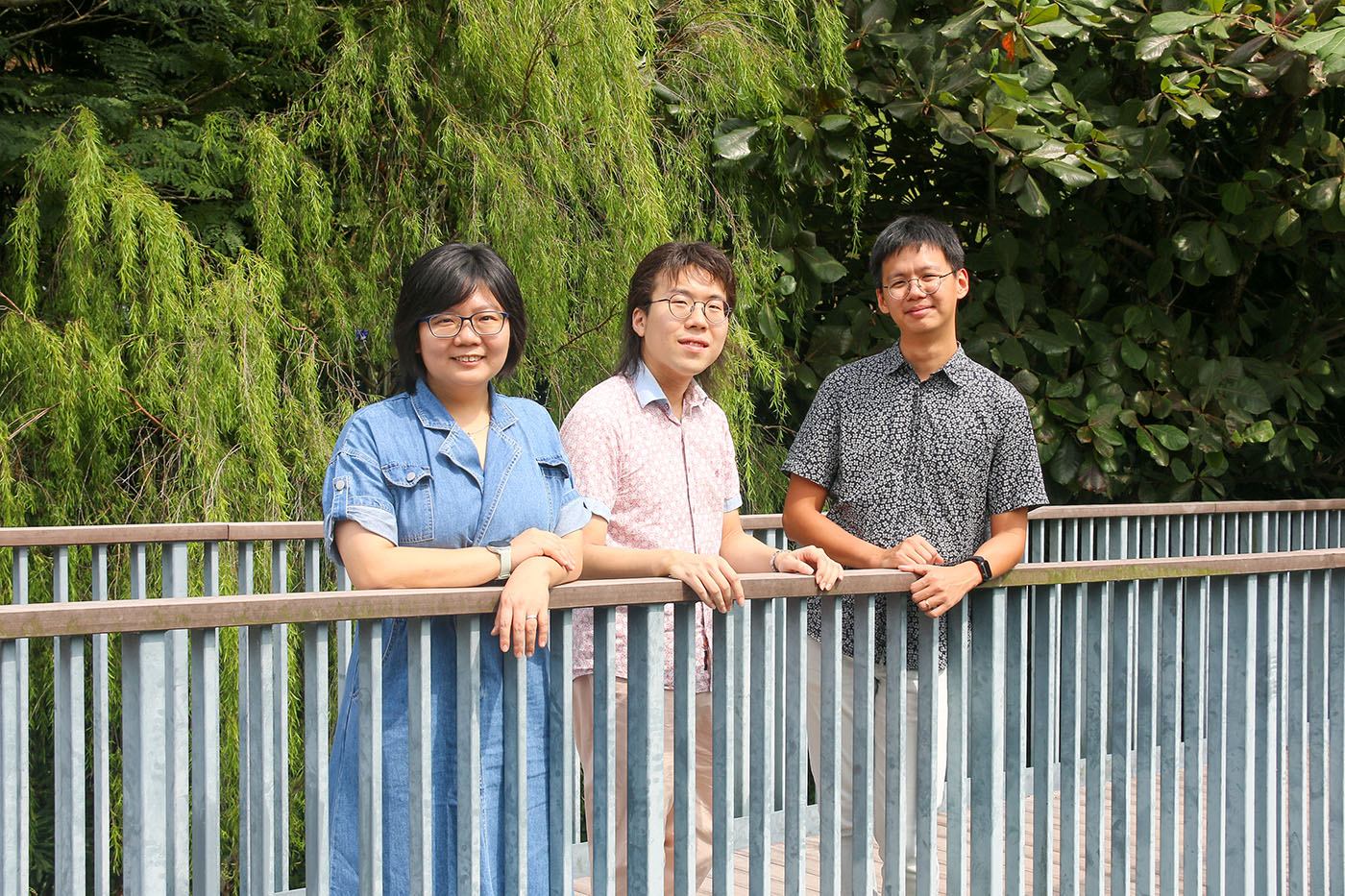
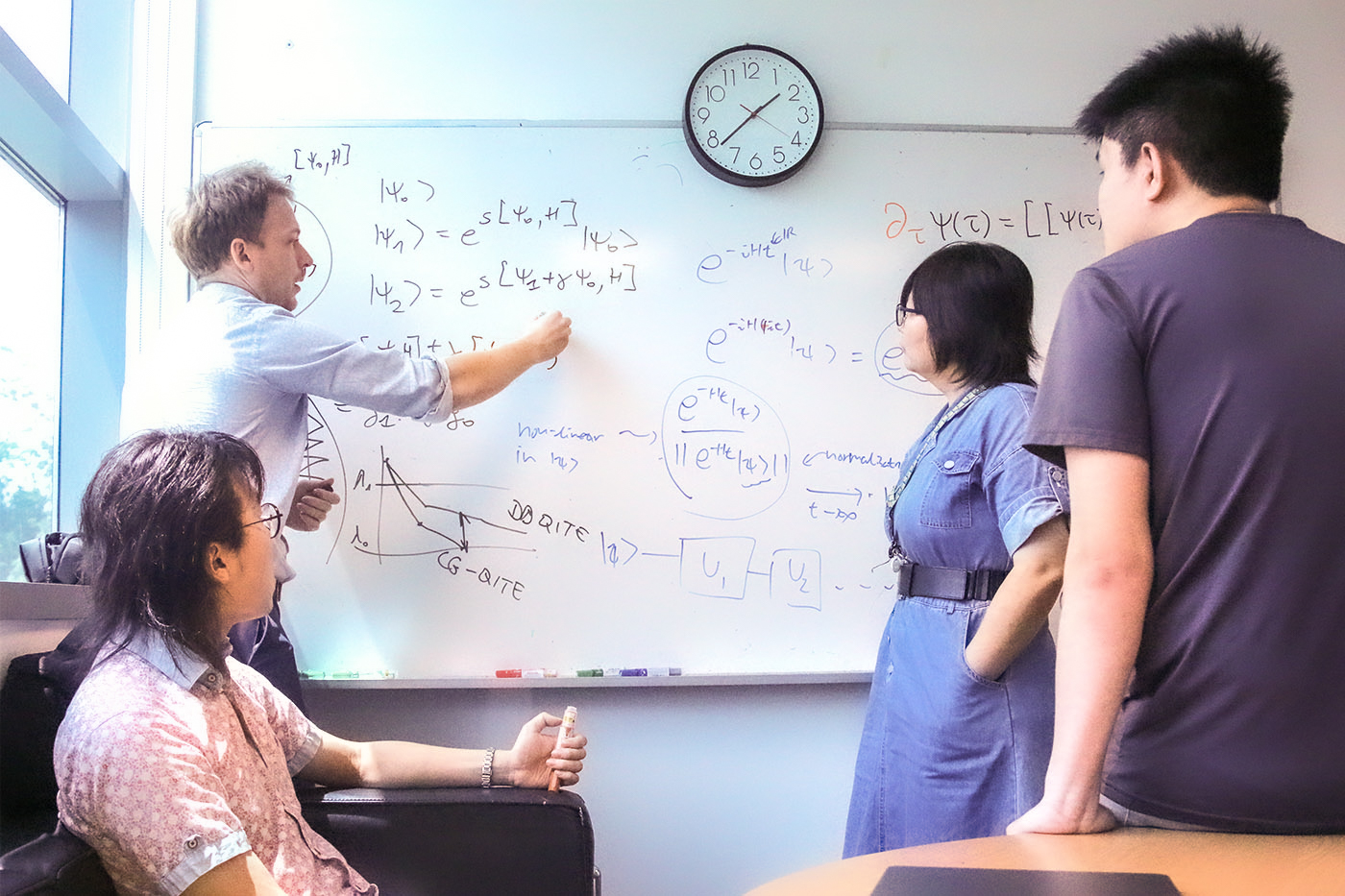
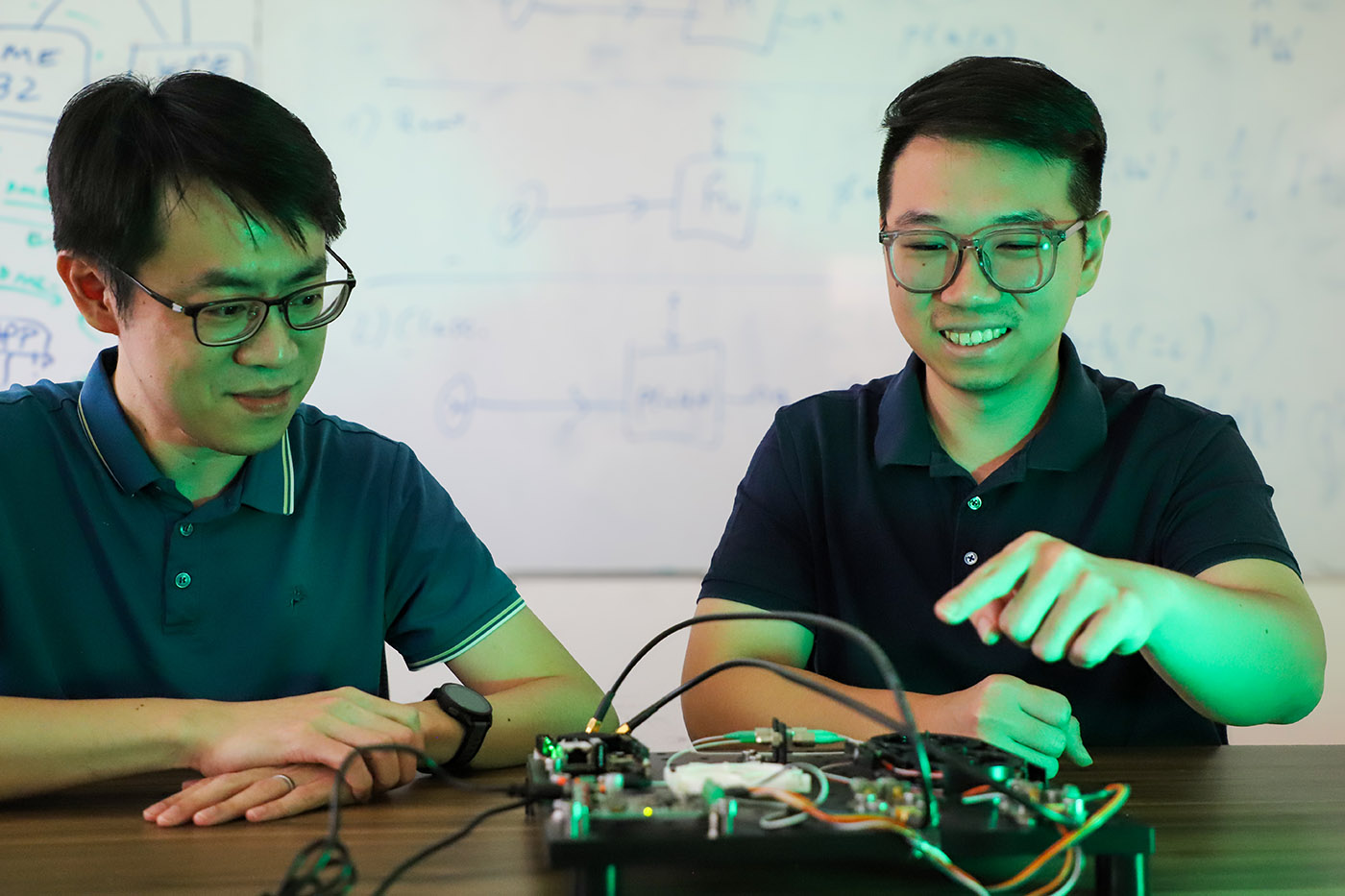
(From left) Researchers Nelly Ng, Jeongrak Son and Ray Ganardi present a new analysis of the conditions for robust catalysis in the quantum regime.
Catalysts can help convert one quantum state to another for quantum computing and communication – but to survive the process, the catalyst must meet one newly identified condition. That’s the conclusion of CQT Fellow Nelly Ng and collaborators in a paper published in Physical Review Letters on 6 February 2026.
Nelly, who is also a Nanyang Assistant Professor at the Nanyang Technological University (NTU Singapore), did the work with her group members Jeongrak Son and Ray Ganardi. Their collaborators are based in France, Japan and South Korea.
Go, or no-go?
Catalysis is a familiar process in chemistry. Well-known catalysts include enzymes that enable biochemical processes in the human body and catalytic converters in cars that break down toxic exhaust fumes. They make chemical reactions possible by providing a new pathway with lower activation energy. Crucially, catalysts remain unchanged during the reaction.
In quantum technologies, researchers want to use catalysts to activate otherwise inaccessible quantum state transitions. The catalyst usually comes in the form of other quantum states, say extra qubits to speed up a computation, or an experimental element, such as mirrors to encourage entanglement.
“With quantum resource theories, we see how putting in an extra system relaxes the mathematical conditions for the transition to happen,” says Nelly, who has studied catalysis for over a decade.
However, such catalysis is usually not robust. When a catalyst receives a quantum state that differs to the expected input – a likely scenario in the real world – in most cases, the catalyst degrades. This affects its future performance, and there are no good ways to systematically control the degradation.
The researchers found that robustness can only be achieved when the catalytic process is fully input-independent. This ‘no-go theorem’ for robust catalysis spells bad news for many previous studies on catalysis in the quantum regime, but not all.
The dynamical picture
To reach this conclusion, the researchers investigated the extent of catalytic processes that are fully input-dependent.
Traditionally, catalysis in the quantum regime was studied as a state transformation process between some initial state and a final target state. The catalyst would be designed and fine-tuned for that transformation.
In this work, the researchers looked at catalysis as a set of possible operations enabled by the presence of the catalyst, defining a channel that enables the transformation to the target state.
“This shifts the static state transformation picture of catalysis to a more dynamical channel picture,” says Jeongrak, who is the first author of the paper.
In the channel picture, any initial state can go through the channel and be transformed into some target state. The researchers found that the catalyst goes through the process unchanged – making it robust – if and only if the channel also has the property of resource broadcasting.
Resource broadcasting
“There is this cheesy quote that says, ‘Happiness shared is happiness doubled’,” says Ray. “The message is that there are certain things that when you share with others, does not decrease the amount you have – this is the idea of resource broadcasting.”
Digging deeper, the researchers investigated what kinds of resources, such as entanglement and coherence, could be broadcast. They found a link to how the states of the system and the catalyst combine, showing they should have the property of being ‘subadditive’.
“This compositional structure has been almost never explicitly explored in prior work, yet remarkably we find that the potential for catalytic channel advantage is governed by it rather than by the specifics of the resources themselves,” write the authors in their paper.
Having considered in this work only how the same type of quantum resource in different systems composes, the researchers are taking next steps to investigate how distinct resources can be composed in a network of quantum agents.