Compact quantum randomness generator emerges from undergrad project
The team achieved 347,000,000 bits of randomness per second from a device implementing the semi-device independent protocol
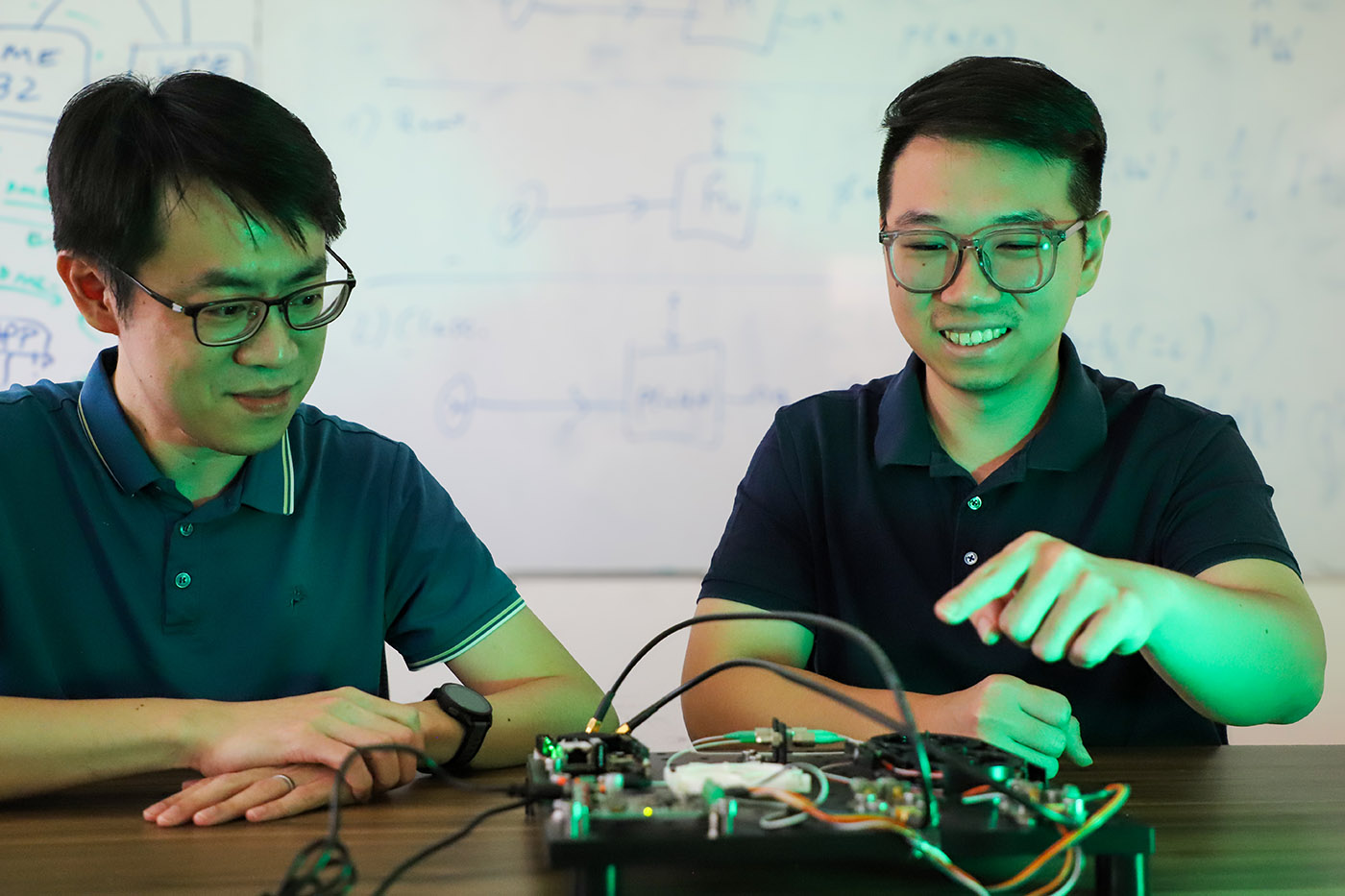
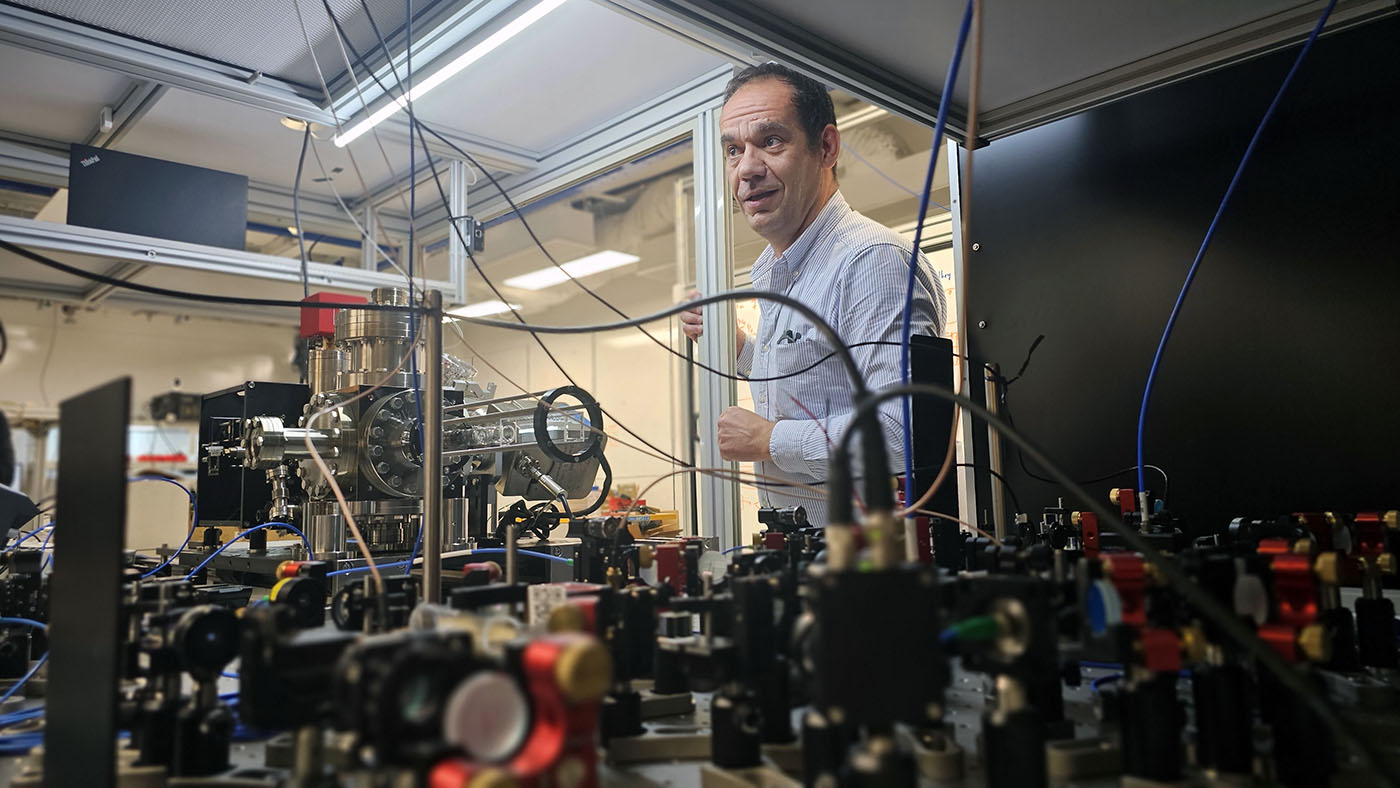
Researcher Haw Jing Yan (left) and PhD student KaiWei Qiu (right) with their quantum random number generator.
A physics undergraduate tasked with building a quantum random number generator (QRNG) managed to simplify his experimental work by upgrading an existing theoretical protocol.
The passive and ‘semi-device independent’ protocol to extract randomness from untrusted light is published in APL Quantum’s December issue. It opens pathways toward compact and high-performance QRNG devices for applications including secure communication.
Former undergraduate KaiWei Qiu is first author of the paper along with researchers Cai Yu, Nelly Ng and Haw Jing Yan, at the Centre for Quantum Technologies (CQT), Nanyang Technological University, Singapore (NTU Singapore) and the National University of Singapore (NUS).
KaiWei has since started a PhD advised by Nelly, who is a CQT Fellow and Nanyang Assistant Professor at NTU’s School of Physical and Mathematical Sciences. His project was for Singapore’s National Quantum-Safe Network (NQSN) Testbed, for which Jing Yan is a Senior Research Fellow. Cai Yu is a NQSN and CQT alumnus, now working on quantum communication at HSBC Bank.
At a sweet spot
QRNGs have long been seen as a promising quantum technology. Commercial devices already exist, including some spun out from research in Singapore.
One market is security applications, since randomness provides a seed for cryptography. For example, random number generators are embedded in the hardware security modules used in communication networks for key management.
In critical cases, physical random number generators are preferred to software-generated ‘pseudo’ random numbers, since those can have exploitable patterns that weaken security.
Randomness from quantum phenomena is appealing because it can be linked directly to the underlying physics. At the extreme, quantum randomness can be certified as coming from probabilities inherent in quantum physics through specific measurements. This is known as device-independent QRNG, but it comes at the cost of speed. Semi-device-independent protocols sit at a ‘sweet spot’ of speed versus security, explains KaiWei. He started working on QRNGs with the NQSN team for his final-year project at NTU.
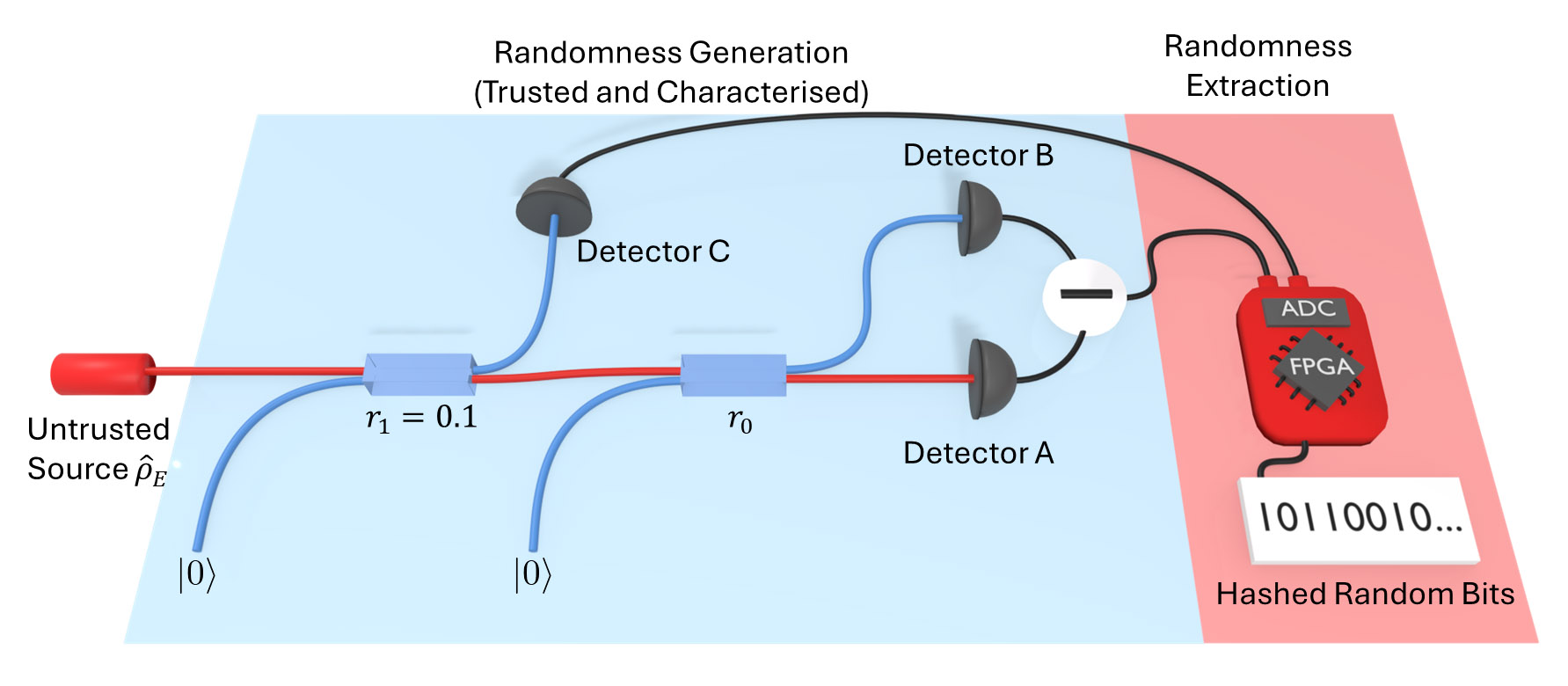
The team started from an existing protocol to generate random numbers from measurements of a laser beam split into two paths. The protocol was already designed to tolerate an untrusted light source by monitoring a small portion of the light source beforehand with an extra detector, meaning that any manipulation of the light could not bias the certified random numbers. However, it required the beam to be split exactly in half.
Experimentally, this means putting a beamsplitter in the device and then repeatedly checking if the split stays balanced, adjusting the setup as needed to ensure the security of the protocol remains intact.
KaiWei’s project involved assembling the lasers, beamsplitters and detectors into the QRNG, plus writing the execution software of the QRNG.
Jing Yan recalls how they started. “For the final-year project, our original goal was to build the device with fully off-the-shelf components, but KaiWei said ‘let me try to improve the theory’.”
KaiWei explains: “Rather than trying to force a balance every day or few hours, back then I was thinking, could I make the theory work in a way that I can just run the protocol and sit back and watch.” He dug into the theory and worked out the full analytical expression that would relax the assumption of having a perfectly balanced configuration.
Eliminating the need to rebalance the beamsplitter means the design uses only passive components, so it is simpler to build and practical to be left running without maintenance.
The team built a device to this design that delivered 347,000,000 bits per second (0.347 Gbps) of randomness, comparable to some commercial QRNGS. They also confirmed the device’s resilience to hacking and showed the random numbers it outputs pass statistical tests defined by the National Institute of Standards and Technology (NIST) in the United States.
Building a beacon
While randomness used for cryptography must be kept private, other applications call for public sharing. KaiWei, Jing Yan and Nelly intend to add their new QRNG to the sources that power the NQSN Quantum Randomness Beacon at https://quantum-entropy.sg/.
This service, which conforms to NIST’s reference implementation, provides 512 bits of publicly accessible randomness every minute. Applications of a publicly verifiable randomness beacon include randomised clinical trials, financial auditing and quality control. The website also showcases demo applications including dice rolls, drawing groups from a set and shuffling a list. NQSN now uses two QRNGs from Singapore startup S-Fifteen Instruments as a source for the beacon.
The randomness output is published with a well-defined structure and is immutable, with all previous pulses kept available for checking. Adding more sources could strengthen resilience.
“For the randomness beacon, the more the merrier,” says NQSN Lead Principal Investigator Alexander Ling. KaiWei will continue to work on this, and his PhD will involve new experimental and theoretical research on measurement-device-independent protocols for quantum key distribution.