CQT to collaborate with Qubit Pharmaceuticals to advance quantum algorithms for drug discovery
Two-year collaboration to develop and implement novel quantum algorithms for molecular discovery; first successful implementation results released
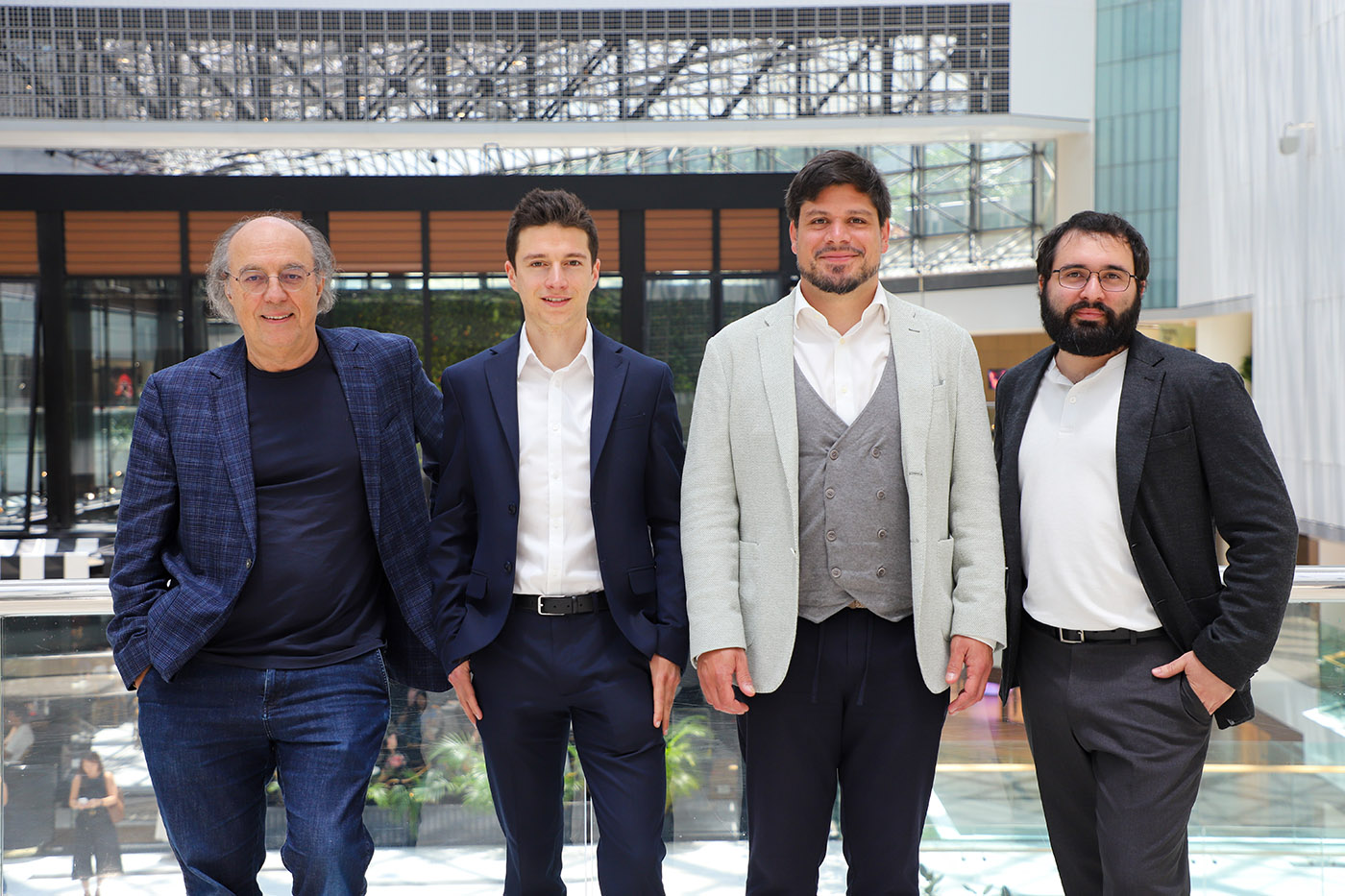
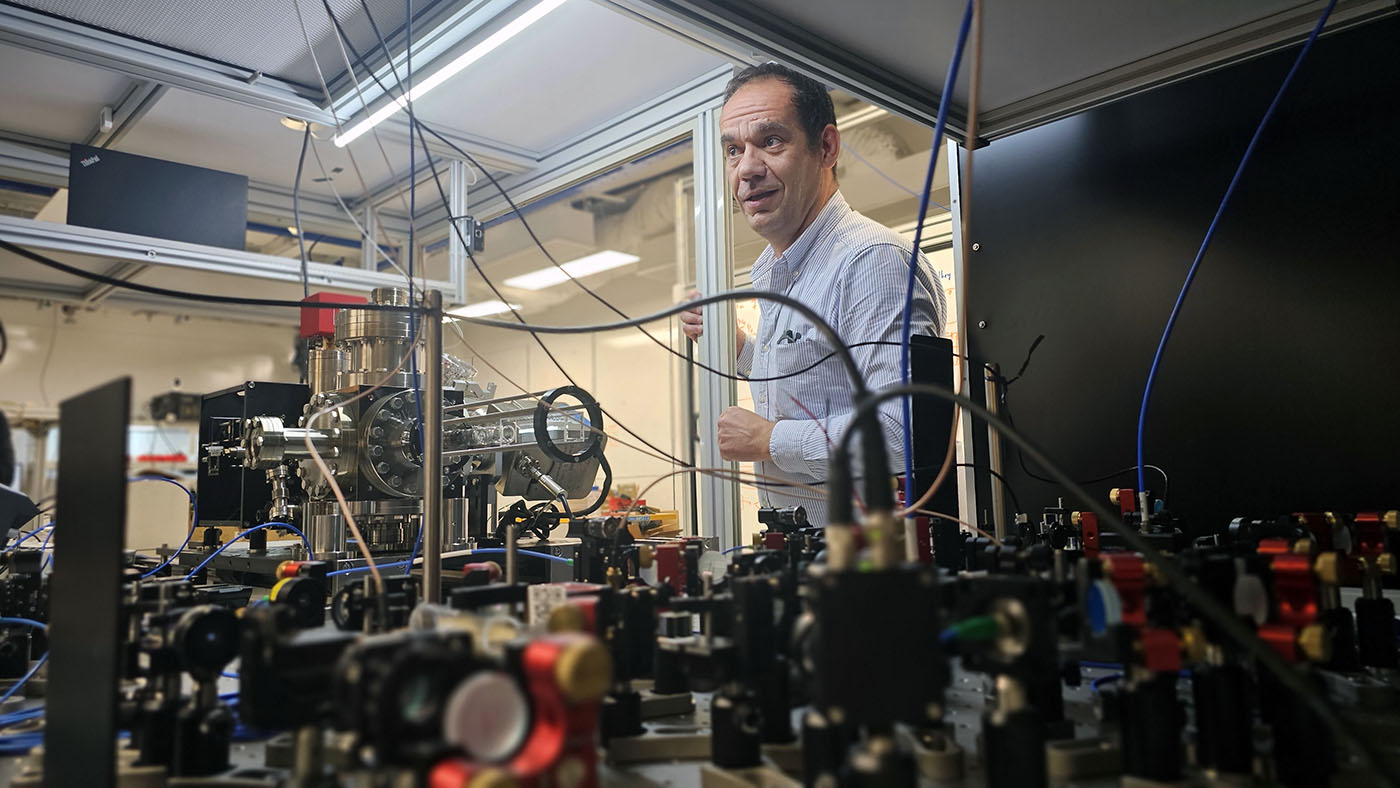
Collaborators from Qubit Pharmaceuticals and the Centre for Quantum Technologies (CQT) met at the Quantum Industry Day in Singapore on 23 April 2026. Pictured from left: José Ignacio Latorre, CQT; Baptiste Claudon, Qubit Pharmaceuticals; Robert Marino, Qubit Pharmaceuticals; Sergi Ramos-Calderer, CQT.
Qubit Pharmaceuticals has announced a strategic research collaboration with the Centre for Quantum Technologies (CQT) in Singapore to develop and use novel quantum algorithms for molecular discovery.
The two-year collaboration combines Qubit Pharmaceuticals’ expertise in quantum chemistry and sampling techniques with CQT’s deep capabilities in quantum computing, circuit design, and experimental implementation. The goal is to bring advanced quantum chemistry methods closer to real-world drug discovery applications.
Together, the teams are designing and testing algorithms for quantum chemistry, including variational quantum eigensolvers, quantum phase estimation, and quantum Markov Chain Monte Carlo (qMCMC) sampling. These algorithms target key computational bottlenecks in drug discovery, such as improving the accuracy of quantum chemistry calculations for better drug property predictions and enabling more efficient sampling techniques for molecular simulations.
“Quantum algorithms for chemistry have been studied for decades, but real implementations remain rare,” said Robert Marino, CEO of Qubit Pharmaceuticals. “By working with CQT and leveraging access to state-of-the-art quantum hardware, we aim to transition these algorithms from theoretical constructs into real computational tools for molecular discovery.”
“Recent progress in quantum hardware is exciting. We want to match this pace in developing quantum algorithms. We are glad to partner with domain experts like Qubit Pharmaceuticals to show what quantum computers can do for problems people care about,” said José Ignacio Latorre, Director of CQT and Provost’s Chair Professor at the National University of Singapore’s Department of Physics.
The researchers aim to explore whether quantum algorithms can approach the highest level of accuracy in molecular simulations while potentially delivering quadratic or even exponential computational advantages compared to classical approaches. They will validate their algorithms on quantum simulators before deploying to real quantum hardware.
The project is supported by Singapore’s National Quantum Computing Hub, through which CQT researchers have access to run experiments on Quantinuum’s quantum systems, including the H2 and Helios systems.
Marino and Baptiste Claudon presented first results from these experiments on 23 April at a Quantum Industry Day in Singapore organised by Quantinuum and Singapore’s National Quantum Office for some 250 invited participants.
The team has implemented the qMCMC algorithm, testing several different encodings. This is the first time this type of algorithm has been deployed to quantum hardware, and the team has published details to the physics preprint server arXiv (https://arxiv.org/abs/2603.08395).
The collaboration is led by Jean-Philip Piquemal at Qubit Pharmaceuticals and Sergi Ramos-Calderer at CQT, with an initial team of four researchers across both organisations. Additional researchers are expected to join as the programme expands.
“Through our collaboration with Quantinuum, we have the opportunity to test quantum algorithms on some of the best gate-based quantum machines available today,” said Ramos-Calderer. “Algorithm design must move hand-in-hand with hardware improvements, and this work is a meaningful step in this direction.”
“Drug discovery is fundamentally a molecular simulation challenge. If we can model chemistry with greater fidelity and efficiency, we can make better decisions earlier in the pipeline,” said Piquemal, Chief Scientific Officer / Co-founder, Qubit Pharmaceuticals. “This collaboration allows us to rigorously test whether quantum algorithms can move from scientific promise to practical utility on problems that matter.”
“We are interested in more than benchmark circuits or abstract demonstrations,” said Claudon, Quantum Physics Engineer, Qubit Pharmaceuticals. “Our focus is implementing algorithms that can address real computational bottlenecks in chemistry. Working with CQT and Quantinuum hardware gives us an opportunity to evaluate these methods under realistic conditions and learn what is required to make them useful for molecular discovery.”
Over the longer term, the team aims to generate real molecular simulation data produced directly by quantum algorithms and integrate these capabilities into future drug discovery workflows.
Related Stories
1 March 2024
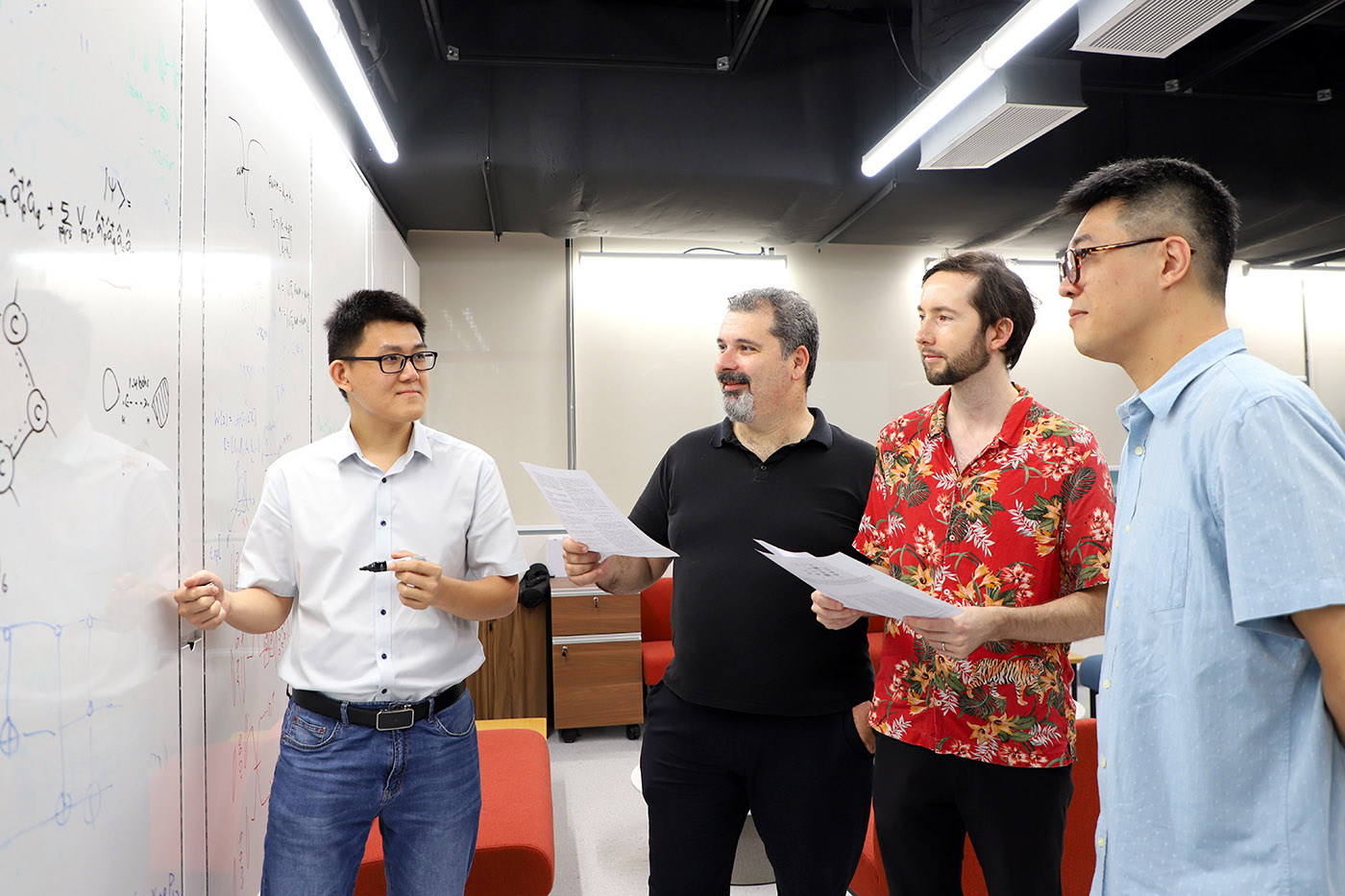
Algorithm calculates bond energies for quantum chemistry
CQT researchers and their collaborators at A*STAR’s IHPC and IBM Quantum have demonstrated a chemistry use case for noisy quantum computers