
Quantum memory achieves near-perfect storage of photons
The design by CQT researchers could have applications in quantum communication networks
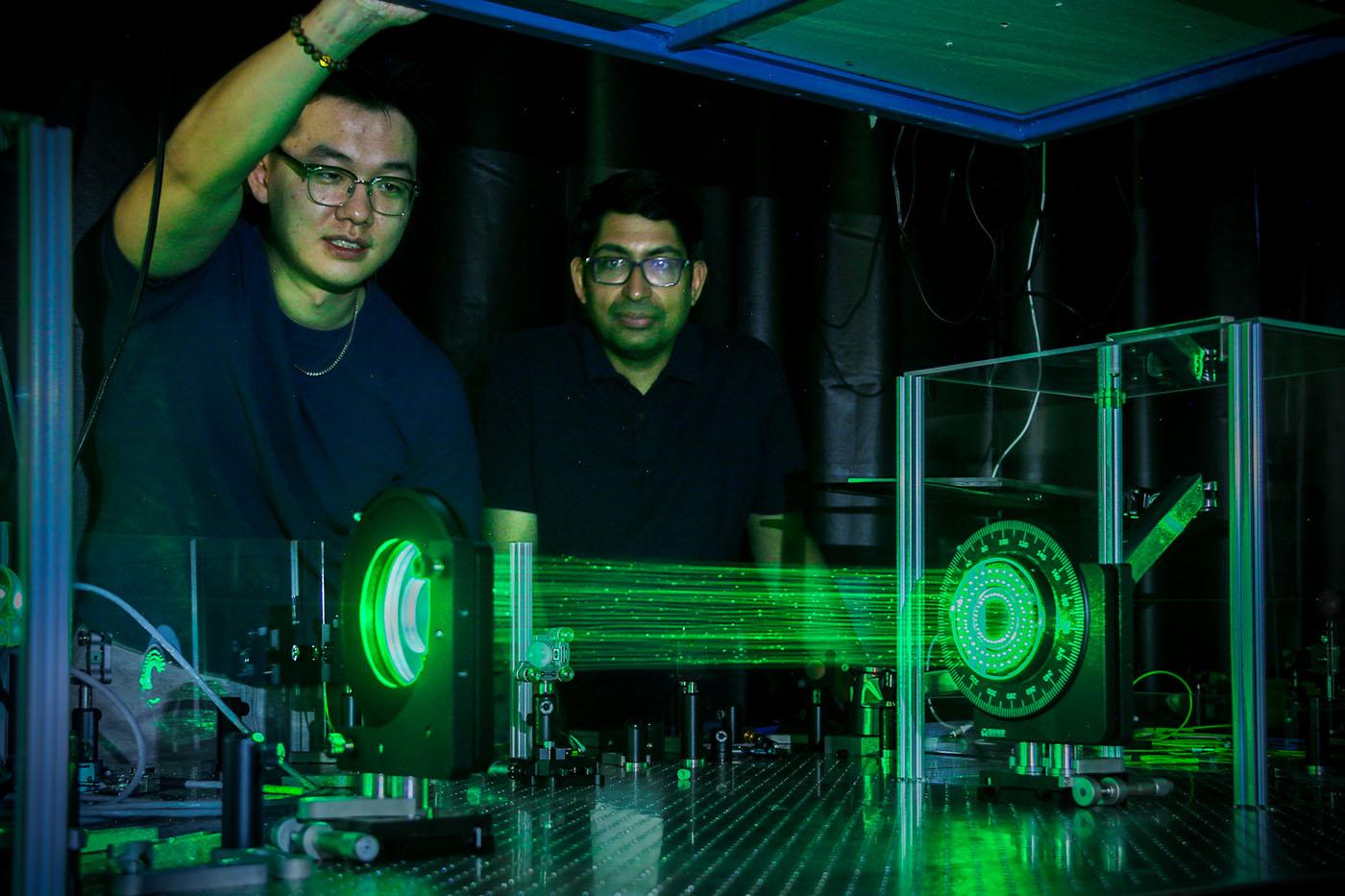
Co-first authors Guo Yu (left) and Anindya Banerji (right) with the quantum memory designed to store photons carrying quantum information. The photo shows green light from a low powered laser undergoing multiple reflections between custom-made mirrors.
Quantum communication networks don’t only send photons, they also need to synchronise them. A CQT team has designed a new highly efficient quantum memory to help coordinate photons’ schedules in a network.
The team’s proposal is published as a featured article on 5 February 2026 in APL Photonics and highlighted on the cover of the issue. The CQT researchers involved in the work are Guo Yu, Anindya Banerji, Chin Jia Boon, Arya Chowdhury and Alexander Ling.
Arrival times
Quantum networks are often asymmetric, meaning the nodes of the network are not connected by equal distances. Synchronisation becomes a challenge because many networking tasks involve collecting photons from different nodes.
Imagine you want to entangle two distant nodes, for example. You would send photons from each node to arrive at some central node to interfere. Unequal distances mean that the photons arrive at different times, so the photon that arrives earlier has to be stored until its counterpart arrives later.
You want a quantum memory that can store photons without loss, allow retrieval of the photons on demand and return the photons with their quantum information intact.
The team have so far shown their setup is promising on requirements one and three, measured as efficiency and fidelity. The setup has two custom-made, high-reflectance mirrors facing each other. Photons are stored as they get reflected between the mirrors multiple times.
In the paper, the researchers report that they can store photons up to 687 ns with an efficiency of 95.3% – meaning only about five in every 100 photons stored get lost. The memory also delivered a fidelity of 99.6%, which means the information the photons were carrying before and after storage is nearly identical.
Compared to a conventional Herriott cell– which is the name for setups that delay light by reflection through empty space between two curved mirrors – they achieve 30 times longer storage times.
“We are storing photons way more efficiently and almost perfectly,” says Anindya, who is a Senior Research Fellow and co-first author with PhD student Guo Yu. “To the best of my knowledge, current state-of-the-art designs have not yet demonstrated this level of performance.”
Mirror mirror
The team’s innovation lies in the mirror design. A conventional Herriott cell only utilised a small part of the mirrors. This limited the number of reflections and so photons could not stay in the cell for long.
The CQT team uses nested mirrors. In their design, each mirror has a smaller mirror that is cemented within it. The larger and smaller mirrors have different curvatures, reflecting the photons in a way that keeps them in the cell for longer.
The researchers also improved the reflectance of the mirrors by having them specially coated. Through conferences, they got to know of companies making high reflectance coatings and found a supplier that could customise a design. They tailored the coating to reflect wavelengths compatible with their entangled photon sources. In the team’s experiment, for photons of wavelengths between 532 nm and 595 nm, the mirrors were coated for more than 99.99% reflectance.
Anindya says, “Because we are just using reflections, as long as we design the cavity well enough, we can preserve all the information that is carried by the photons.”
The team also compared the efficiency of their design to ultra low loss (ULL) fibres, the most efficient way in which photons can be stored in fibre. Comparing for similar storage times, they found that their setup had higher efficiencies – the first time that a free space delay line outperformed ULL fibres.
While the researchers had their mirrors custom made, they say that the cost is still more affordable than quantum memory designs based on atomic systems that require more complicated setups.
What’s left is for the team to convert their design into an on-demand quantum memory, to meet the final requirement for networking. They need to be able to decide for each arriving photon, whether that photon should be stored and for how long. For this, they are building another component known as an optical switch.
“What we would really like to have is a fibre-in-fibre-out system,” says Anindya. “The quantum memory and optical switch can sit on separate racks within the same server module and form a complete system.”