Meet a CQTian: Lim Zi Way
Interest piqued by an undergraduate project, Zi Way applied for a PhD under the National Quantum Scholarships Scheme to continue work on quantum sensing
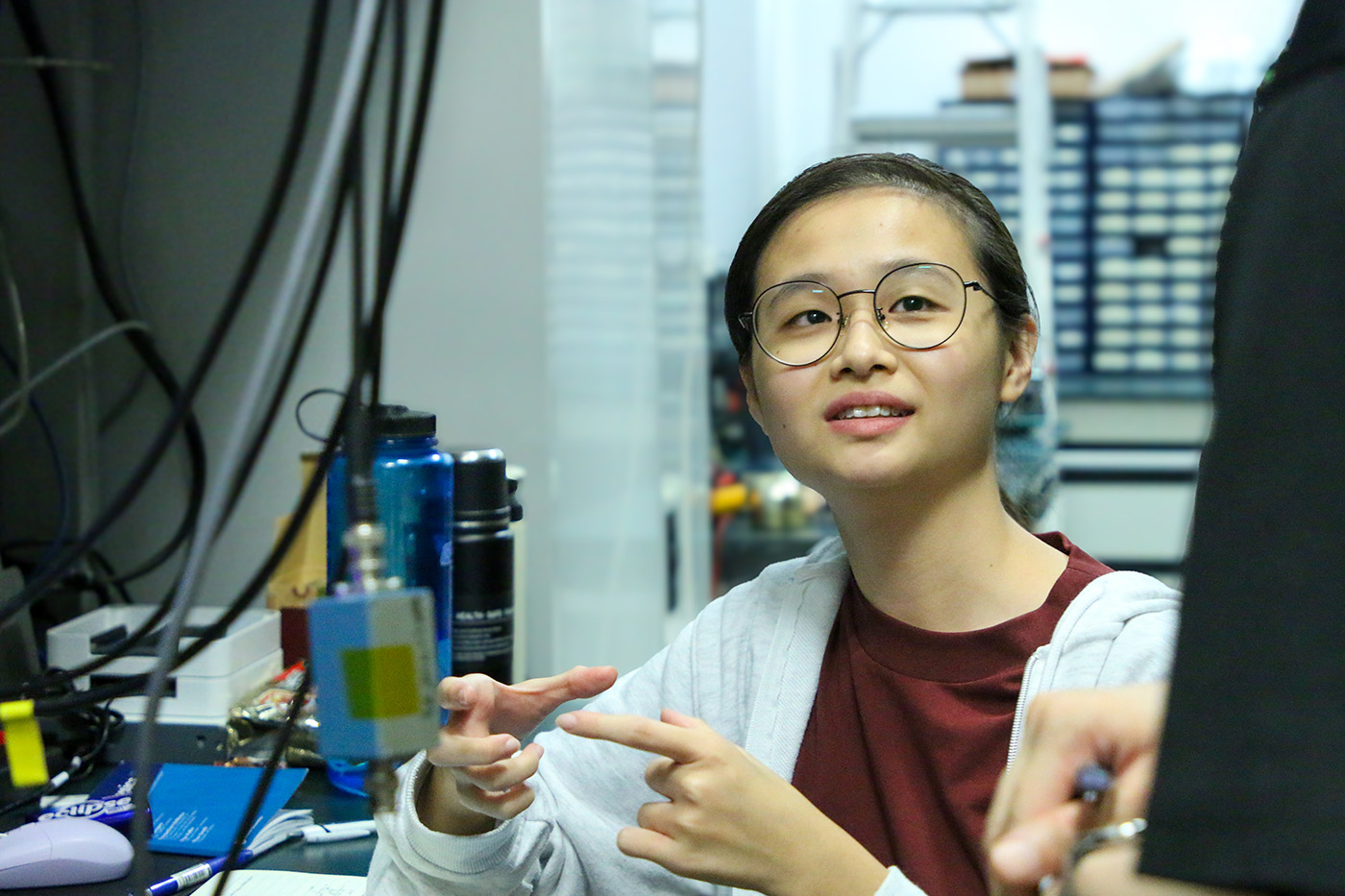
Zi Way is making a compact laser system for an atomic accelerometer.
Who are you and how did you come to CQT?
I’m Zi Way and I’m a first-year PhD student at CQT. I did my Final Year Project (FYP) with Principal Investigator Rainer Dumke’s group while I was an undergraduate at the Nanyang Technological University. I was helping to build a laser system to cool rubidium atoms in our accelerometer.
The atomic accelerometer is a very sensitive tool that measures acceleration through the motion of cold atoms. Atoms are cooled to micro-Kelvin temperatures and released into free fall within a vacuum chamber. We use laser pulses to manipulate their trajectories, forming an interferometer where the phase accumulated is proportional to acceleration.
I found it very hands-on and fun. Then, Rainer told me that he wanted to build something smaller, maybe halving the size of the entire accelerometer from its current size which is roughly one metre tall. Since my FYP was just a small part, I thought doing a PhD would let me see the bigger picture and I applied under the National Quantum Scholarships Scheme.
Can you say more about the project you worked on for your FYP?
To cool the rubidium atoms, we use laser frequencies that are based on the D2 line of rubidium-87. The D2 line corresponds to the transition of an electron in the atom between two different energy levels.
I worked on the optical alignments and optimisation of an acousto-optic modulator, which is a device we use together with the laser to match the required transition frequencies.
What are you working on now?
I’m working to build a more compact version of the laser system so that it fits within the size of an A5-sized paper, maybe even smaller. Now, I’m mostly reading papers to learn more about the theory because we are still in the midst of deciding what to include in the design of the laser system.
What are you enjoying?
There is a lot to do and learn. It is not just physics – there is engineering and coding too, for example. Learning the skills to make the project work is what I enjoy the most.
How did you get interested in quantum physics?
It was during junior college. At the time we were being taught quantum, it was during COVID and we had home-based learning. I enjoyed what I was learning and since I was at home every day, I spent time reading up and watching videos related to various fields of quantum. My interest grew during my undergrad years when I started doing more work related to quantum and talking to people who work in quantum.
What do you enjoy outside of work?
I like playing Rubik’s Cube. I used to play it competitively but now I don’t have a lot of time. I did the Pyraminx, a tetrahedron shaped puzzle, and once held the national record for the fastest single solve. Now I’m more into the four-by-four-by-four cube and playing blindfolded.