Bright photonic chip could power quantum networks
Singapore researchers demonstrate entanglement distribution from the chip over 155km

Silicon photonic chips could be a key component in future quantum networks. Researchers from the Centre for Quantum Technologies and the Singapore University of Technology and Design (SUTD) have trialled a new chip design on Singapore’s fibre network, distributing entanglement between Nanyang Technological University and SUTD.
Researchers at the Centre for Quantum Technologies (CQT) and the Singapore University of Technology and Design (SUTD) have sent polarisation-entangled photons from an integrated photonic chip over a record distance of 155 km of deployed fibre. They report their results in the 1 December issue of Newton.
The feat comes from the combination of a new, bright and made-in-Singapore chip design and techniques to manage the photons’ journey through a network.
The team’s chip is the brightest reported – generating up to 2.8 million entangled photon pairs per second in fibre, a thousand times brighter than previously reported results. The team also pioneered techniques to counter noise in their detections.
Quantum networks that carry entangled photons are interesting for their promise to provide secure communication and connect distant quantum computers. Photonic chips, which can generate, process, and detect light particles, could be integral components.
The researchers trialled their chip on Singapore’s National Quantum Safe Network (NQSN) testbed. Their demonstration is the first time such a chip has been taken out of the lab and used for long-haul transmission over deployed fibre.
The work was shared: at CQT, researchers led by Principal Investigator Alexander Ling designed the chip and ran the trials while at SUTD, a team led by Associate Professor Dawn Tan carried out the fabrication. Alexander is also the lead Principal Investigator for NQSN and a Professor at the National University of Singapore’s (NUS) Department of Physics.
Small and bright
Silicon chips are attractive for networks because they are small and cost-effective, but they had lagged the brightness of sources based on bulkier optics.
A bright source is essential because photons get scattered in fibre. In the team’s demonstration, for example, the 155 km fibre had a loss of 66 dB, meaning only about one in four million photons completed their journey.
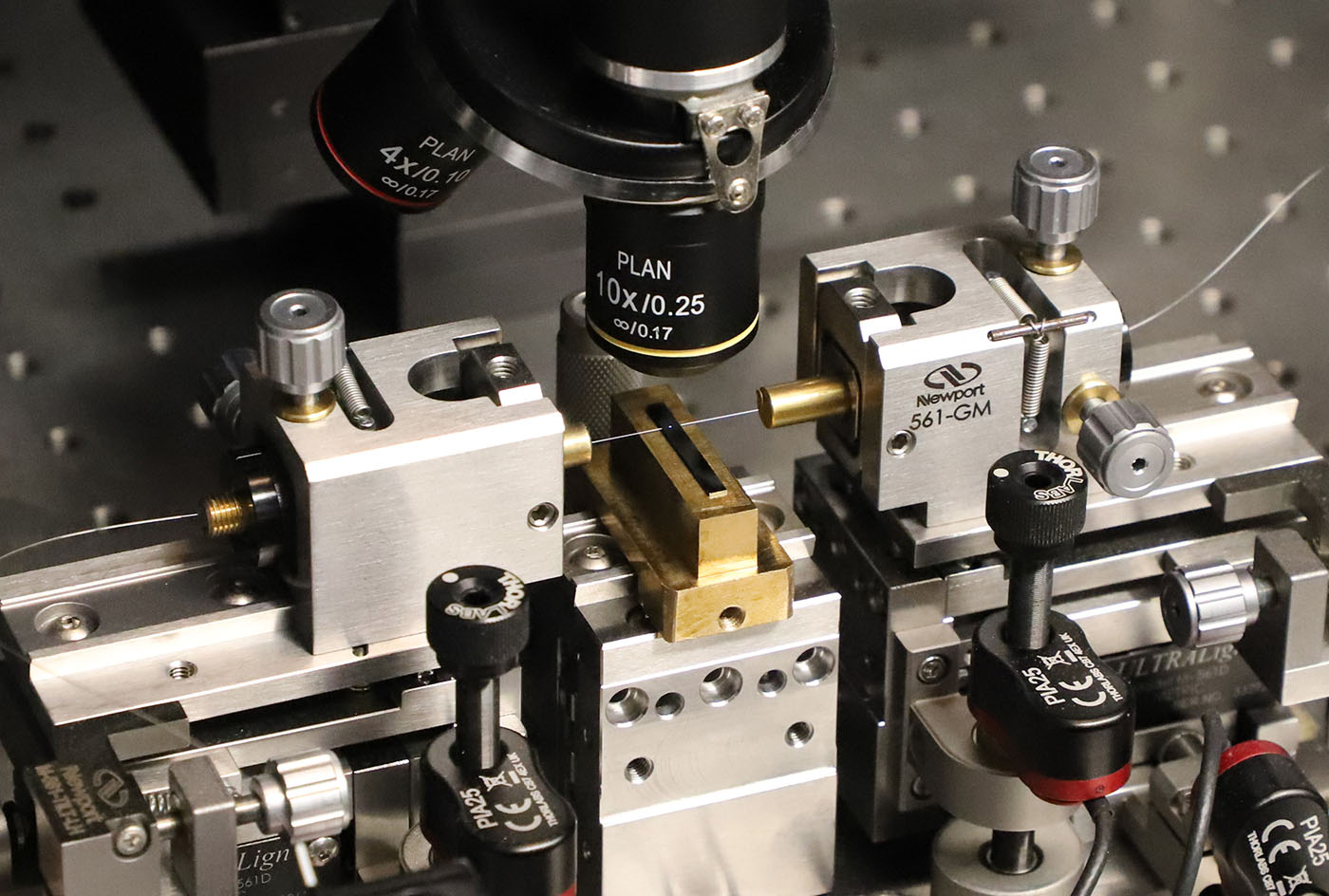
CQT Research Fellow Du Jinyi, first author of the publication, earned his PhD at CQT working on techniques to achieve brightness and enable long-distance entanglement distribution. His first publication reported a coupling design to increase the efficiency of collecting photons from the chip into fibre, presenting a recipe for preparing high-efficiency fibre tips for chip coupling. The method has since been adopted by several other research groups.
This latest demonstration adds optimisation of the ‘coincidence-to-accidental ratio’ (CAR) – better distinguishing genuine entangled pairs (coincidences) from background noise (accidentals). “Once accidentals contaminate the coincidence counts, the source quality is already degraded,” says Jinyi.
To generate entangled photons, the researchers inject a pump laser into the chip. This triggers a process known as spontaneous four wave mixing, generating entangled photon pairs at a wide range of wavelengths. Sending more photons from the pump laser makes more entangled photons but also makes more noise.
The researchers found they could improve the outcome with strong spectral filtering. They noticed that CAR peaks for certain wavelengths of entangled photons (1540 nm and 1560 nm in this experiment) and filtered for these wavelengths.
Going the distance
The researchers trialled their bright chip on the NQSN testbed over fibre provided by telecommunications company NetLink Trust. The source was located at NUS. From each entangled photon pair, one photon made a round trip to the Nanyang Technological University (NTU Singapore) and the other went to SUTD and back. The total distance travelled by the entangled photons is over 155 kilometres.
On their journey, the entangled photons could lose their entanglement through effects such as chromatic dispersion, phase drift and polarisation drift. The team implemented a nonlocal dispersion compensation scheme and an original phase-stabilisation method to correct for the first two effects. They found that polarisation drift was not significant.
Polarisation drift is when the polarisation of the photons rotates as they travel through fibre. Because Singapore’s fibre network is laid underground and the temperature does not fluctuate much, the researchers found that the polarisation behaviour was stable.
The researchers measured that the entanglement fidelity, how similar the entangled state was to an ideal Bell state after the distribution, was 87.6%. This performance is competitive with entangled photon sources based on bulk crystals.
Next, the researchers want to see if a single chip can support multiple users in the network. Jinyi says, “We filtered for only two wavelengths of the entangled photons that were generated, but we could possibly use more wavelengths and so connect many more users in the network.”
The team’s source also shows promise for future applications in satellite-to-ground quantum communication. The source bridged a total channel loss of 66 dB. This exceeds the 62 dB loss reported for the Chinese satellite Micius, in an experiment where the satellite sent entangled photons to two ground stations simultaneously.
The team believes they can extend their optimisation approach to other integrated photonics platform.